
Bladen County Parole and Probation
North Carolina uses three forms of community supervision that sound alike but are not the same. Probation is imposed by a court, often instead of an active prison term or after a sentence is suspended. Parole is a discretionary release from an older-law prison sentence for someone who remains legally eligible. Post-release supervision, often shortened to PRS, is the required community portion of many structured sentences. It is not a parole award. In Bladen County, the North Carolina Department of Adult Correction, or NCDAC, maintains the public status record and Community Supervision carries out field supervision.
The distinction affects what a result proves. A probation entry may exist without a recent prison release. A parole entry generally points to an eligible older sentence. A PRS entry follows a state prison term governed by structured-sentencing law. None of those labels proves that the person was released from the Bladen County Detention Center, since NCDAC expressly excludes local jail records. A later Bladen arrest can also occur while an older supervision entry remains visible.
| Status | How it begins | What to verify |
|---|---|---|
| Probation | A court orders community supervision, often with a suspended sentence. | Current status, sentence component, court case, and the office shown by NCDAC. |
| Parole | The Commission grants release for a legally eligible older-law prison sentence. | Parole status, release history, review outcome, and Commission record boundaries. |
| Post-release supervision | State law places a qualifying structured-sentence person under supervision after prison. | Actual prison release, active PRS status, office, and later termination or discharge. |
The official Community Supervision overview shows the state agency behind these records.
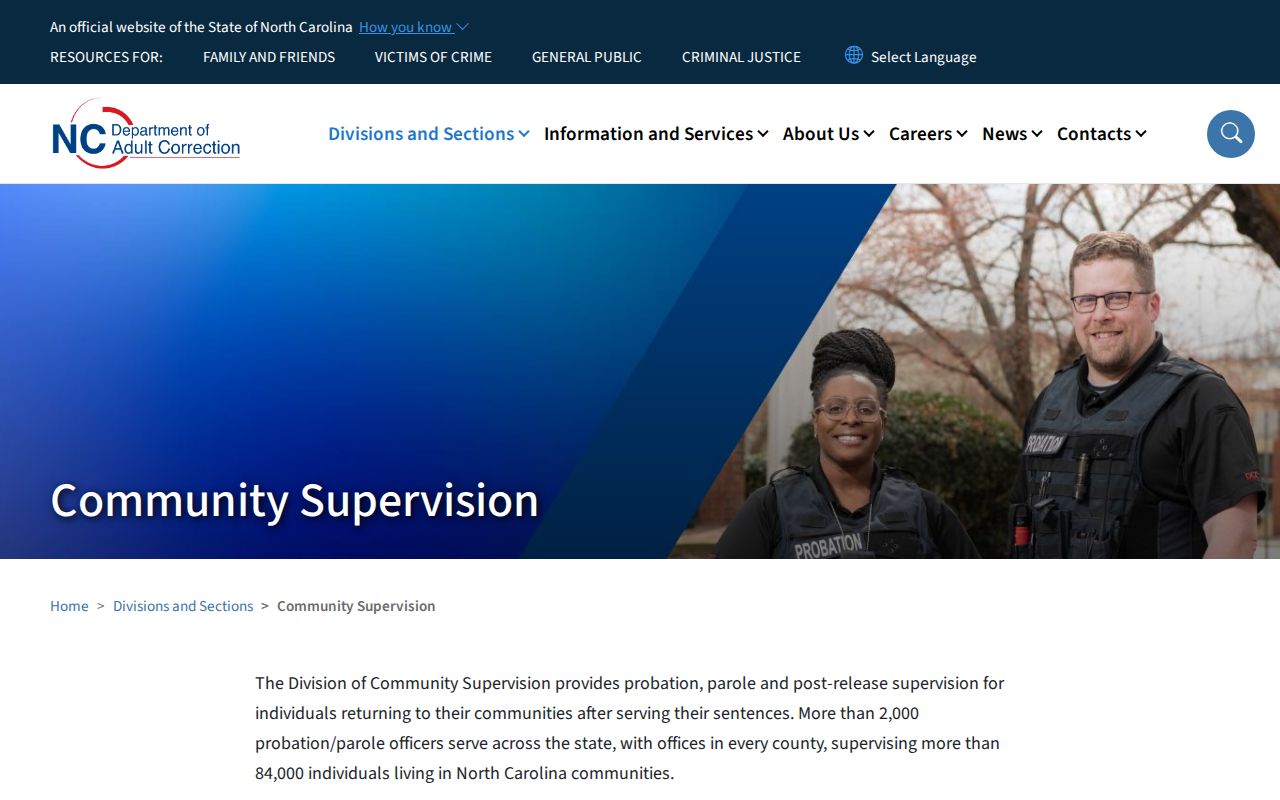
That agency page is a useful starting point, while the person-level NCDAC record supplies the status needed for an individual Bladen County supervision check.
- Discharge
- The formal end of a supervision term, separate from release from physical custody.
- Absconder
- A person NCDAC alleges is actively avoiding probation or parole supervision.
- Detainer
- A request or hold that can lead to another agency taking custody instead of community release.
- Revocation
- A legal action that can return a supervised person to custody after a violation finding.
Verify Bladen County Supervision
The official public path begins with the NCDAC Offender Public Information Search. It covers state prison offenders, probationers, parolees, and historical state records dating back to 1972. It does not contain a jail-only Bladen booking. An offender number is the safest key. When only a name is known, compare age or date information, conviction county, sentence dates, and other identifiers before treating a result as a match.
- Search the person by offender number when available. Otherwise use the name fields and account for aliases or spelling differences.
- Open the matching detail. Read incarceration status, release dates, sentence components, and the “Probation/Parole/Post Release Status” field.
- Find the “Probation/Parole Office” field. Use that office from the record rather than guessing from a Bladen address.
- Check the official Community Supervision directory for the office’s current phone and address because district routing can change.
- Check current Bladen or other custody sources if a later arrest is possible. Active supervision does not bar a new jail booking.
- For a jail-only episode, contact the Bladen County Detention Center and request its booking and release entry. NCDAC cannot certify that local record.
Read all sentence components. One person can have more than one conviction, admission, release, revocation, or supervision episode. A past “released” line does not cancel a newer active component. For broader release-record routing, the Bladen County released inmate search distinguishes the sheriff, court, state, and federal channels.
Note: A name match alone is weak proof; confirm the offender number, sentence history, dates, and county before relying on the status.
Bladen County Supervision Office
NCDAC has Community Supervision offices across the state, but the Bladen-area assignment should not be inferred from geography. Judicial districts and office routing can change. Start with the office printed in the individual offender record, then confirm its current details in the NCDAC district and local office directory. This prevents calls to an office that no longer handles the case.
North Carolina Community Supervision
Routing: Use the office listed on the person’s NCDAC detail, then verify it in the official directory.
NCDAC main office:
214 West Jones St.
Raleigh, NC 27603
(919) 733-2126
Public records: NCDAC Public Records
Public locator fields and basic office confirmation are the practical access route. Community-supervision case files are generally confidential under G.S. 15-207. Officer notes, risk assessments, private contact details, and treatment information should not be expected through the public search or a broad records request. NCDAC’s records page explains which basic conviction, sentence, admission, time-served, and release facts are public and which supervision material remains protected.
Bladen County Absconder Status
An absconder listing is a specific state-supervision record. The official NCDAC absconder search identifies people alleged to be actively avoiding probation or parole supervision. It is not a list of people released from the Bladen jail, and it is not proof of a new local booking. Likewise, a probation violation, an arrest warrant, and an absconder designation are separate events that may arise from different records.
No official public Bladen Sheriff warrant or absconder list was located in the research. Use the NCDAC result, the relevant court case, and direct agency contact instead of a commercial warrant page. If a person appears in the state absconder search, do not approach them. NCDAC publishes a constituent tip line at 1-888-646-0024. A listing reflects an unresolved supervision problem, not a lawful discharge date.
The manifest-captured NCDAC absconder screen illustrates the official search channel.
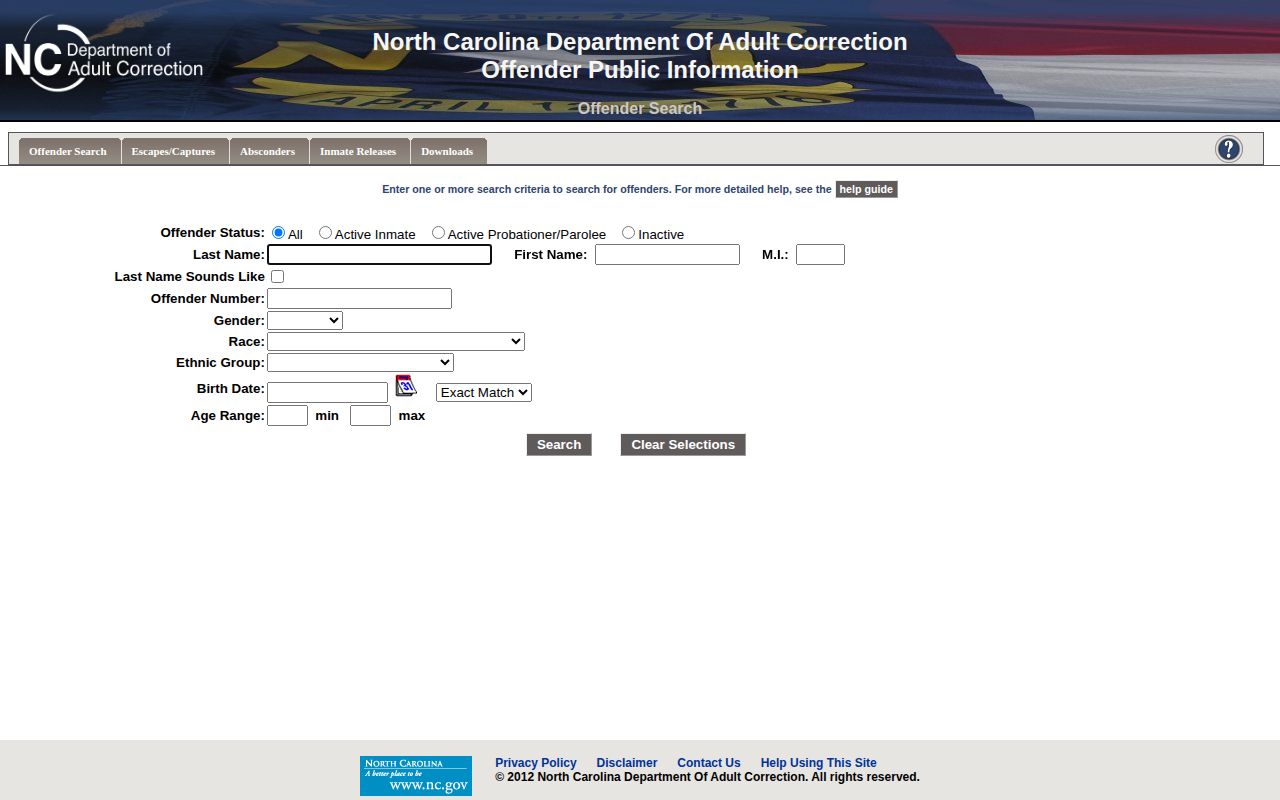
The result must still be tied to the correct person and read beside court and fresh custody information.
Note: An absconder result signals alleged supervision avoidance; it does not establish community release, a Bladen warrant, or current jail custody.
Bladen County Parole File Review
North Carolina does not use a conventional public, face-to-face hearing calendar for ordinary parole review. The North Carolina Post-Release Supervision and Parole Commission says commissioners review eligible files independently and a majority decides. There is no public named-person hearing schedule to search. Case analysts calculate eligibility, schedule reviews, obtain material, and process decisions through the Commission’s administrative model.
Eligible cases are generally reviewed at least once each year after eligibility. Certain murder cases are reviewed every three years, while sexually violent offenses are reviewed every two years. Weekly victim or input meetings are by appointment, last 30 minutes, and are not offender hearings. The monthly Discretionary Parole Reviews, available from September 2024 forward, are the official decisions substitute. They are monthly files, not a public person-name search.
Reported outcomes can include an incomplete decision while more facts are gathered, a suspended decision, regular parole, community-service parole, early medical release, or 90-day mandatory parole. Underlying Commission records remain confidential. Ordinary parole generally applies to eligible offenses committed before October 1, 1994. Structured sentencing removed it for most later offenses, with narrow exceptions. G.S. 15A-1371 controls older-law eligibility and review, so a headline date formula is not reliable.
Bladen County Supervision Violations
Conditions are the rules attached to probation, parole, or PRS. The exact terms come from the court, the Commission, and NCDAC records for that case. Public status pages may show that supervision is active, but they do not disclose a full case plan. A violation allegation can lead to added review, a court event, arrest, or revocation, yet none should be assumed from a stale or partial search result.
For a status change, compare the offender detail with the Bladen court docket when a local case is involved. NC SAVAN may also carry supervision events, including absconding, capture, termination, or discharge, for people covered by the victim-notification law. A notification is useful corroboration, but the responsible court or corrections agency remains the source for the legal action. If the person has returned to the Bladen County Detention Center, the sheriff’s current custody and booking record controls that new local episode.
Bladen County Supervision Discharge
Prison release and supervision discharge are separate milestones. A North Carolina record may show an actual release from prison followed by active parole or PRS, then a later termination or discharge. Probation likewise ends according to the controlling court and supervision record, not because the person is absent from a jail roster. Anyone asking whether the whole sentence is over should confirm both the custody release and the supervision end status.
Structured sentencing generally applies to offenses committed on or after October 1, 1994. NCDAC explains that the person serves the full minimum and at least 85 percent of the maximum, with qualifying release ordinarily followed by PRS. That does not mean everyone is simply paroled at an 85 percent mark. The judgment, offense date, sentence type, earned-time record, and statutes control. Older cases may remain parole eligible, while newer structured cases commonly move into statutory supervision.
When the public display lacks the needed end date, use NCDAC’s formal records route with the offender number and the exact field sought. Confidentiality still applies. For a court-ordered probation end, the Bladen court case and clerk-issued order can provide the legal context. Keep the prison release date, supervision status, and discharge date distinct in any notes or request.
Note: Confirm the supervision end date itself; an old prison release date does not show that parole, probation, or PRS has ended.