
Bladen Projected and Actual Releases
A projected release date is a calculation, not a record that the person has walked out. For an active North Carolina prison sentence, the North Carolina Department of Adult Correction may display the estimate in the Most Recent Incarceration Summary and sentence history. An actual release date records a completed state-custody event. Neither label should be treated as the exact time someone will leave the Bladen County Detention Center. The sheriff, court, and NCDAC keep different parts of the custody story.
A pretrial detainee presents a different problem. No sentence calculation exists when the case is still pending. The next event may depend on bond, a written promise, a custody release, dismissal, a court order, or another agency taking custody. Even a court-set bond does not predict when its terms will be met or when jail processing will finish. For that person, ask the Detention Center about current status and read the Bladen court case for the legal authority.
Search Bladen Projected Release Dates
Start with custody type. The NCDAC Offender Public Information Search covers state-prison offenders and people in probation, parole, or post-release supervision records. It includes history beginning in 1972, but it expressly excludes Bladen County jail records. A person held only in the county jail will not gain an NCDAC projected date merely because the arrest happened in North Carolina.
- Search NCDAC by offender number when it is known. Otherwise, use the committed name and account for aliases or spelling differences.
- Match the person through the offender number, identifying details, conviction county, docket, sentence dates, and status. A name match alone is weak proof.
- Open the incarceration summary and each sentence component. Record the exact labels for projected date, actual date, minimum, maximum, and supervision status.
- For a Bladen jail sentence, call the Detention Center and obtain the judgment or commitment from the Clerk. Ask about jail credit, orders, and any receiving hold.
- Check again near the date. Confirm whether the result means community release, post-release supervision, or transfer to another custodian.
The official search can show several convictions, admissions, releases, or revocations for one person. Read them as separate episodes. A past actual release beside an older sentence does not cancel a newer active component. Likewise, a community-supervision label usually means the person is outside state prison under conditions, but it cannot rule out a later county or federal arrest.
For a broader state cohort, the NCDAC Inmate Release Search covers people released from state prison in the current year or prior two years. It searches by release county, month and year, or surname. This monthly statewide tool is not a Bladen jail release feed.
Bladen Release Date Record Fields
An NCDAC detail record must be read as a group of connected fields. The label and sentence component matter as much as the date. A projected date in one incarceration summary may coexist with an actual date from an earlier term. The court judgment supplies the imposed sentence, while NCDAC applies credits and correctional rules to a state term.
| Field | What it helps confirm |
|---|---|
| Offender number and status | Identity and whether the matched state record is active, released, or under supervision |
| Projected release date | NCDAC's current estimate for the listed state sentence component |
| Actual release date | The date a prior state-custody episode ended |
| Sentence begin and terms | The start, minimum, maximum, and structure used in the state calculation |
| County, docket, and offense | Clues for matching the NCDAC component to the correct court judgment |
| Probation, parole, or PRS status | Whether a correctional release may be followed by community supervision |
The official NCDAC example record observed during research shows how these labels can appear together. The linked structured-sentencing statute supplies the source shown in the image.
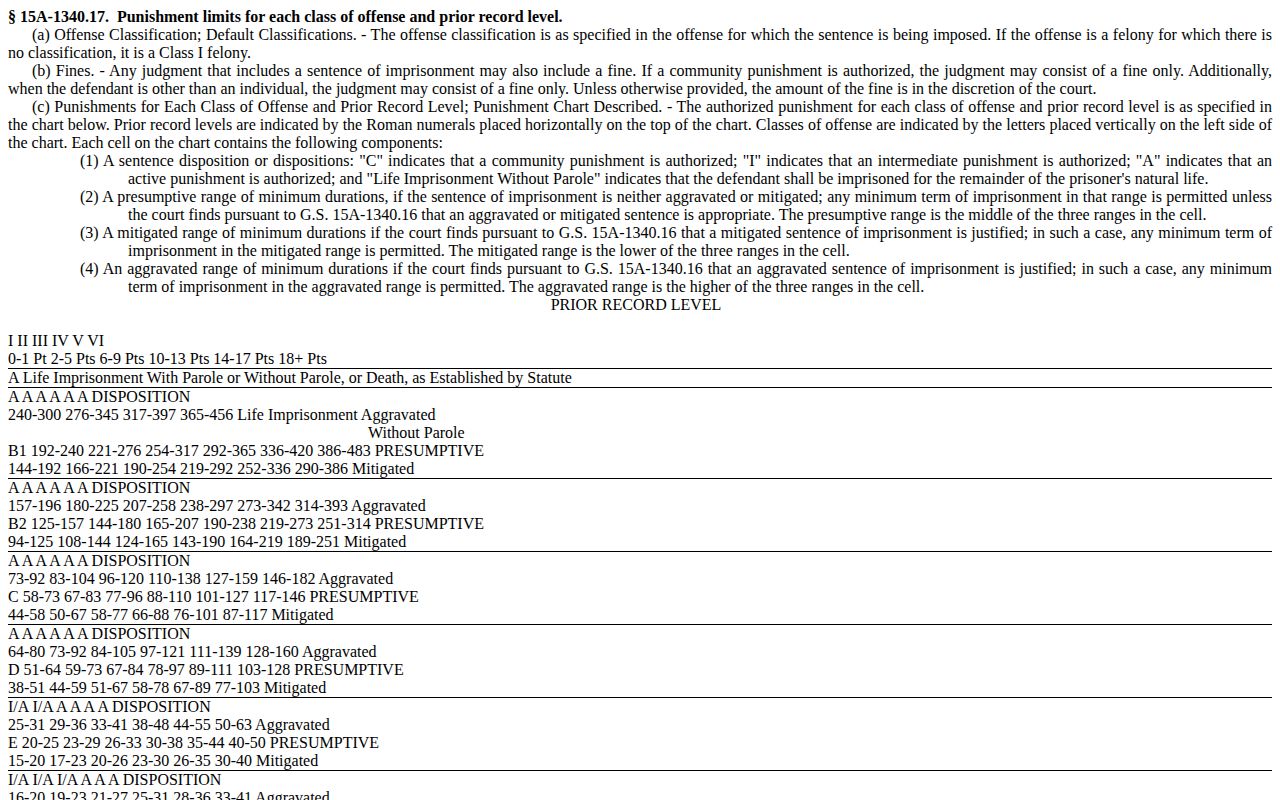
The captured statute page anchors the calculation in North Carolina law, while the live offender record remains the source for a person's current displayed date.
If the public detail omits a needed basic field, use the NCDAC public-records route and include the offender number. NCDAC identifies conviction, sentence length, time served, admission, and release dates as public basic information, while more sensitive correctional records can remain confidential. A records request does not expand what the law makes public. It also cannot supply a Bladen County jail date because NCDAC does not maintain local jail records. Direct that part of the question to the Sheriff and Clerk instead.
Note: Public offender records can change, so record the offender number, exact field label, source, and date checked before comparing results.
North Carolina Release Date Math
North Carolina structured sentencing does not support a simple “everyone serves 85 percent” shortcut. For an active structured felony term, G.S. 15A-1340.17 supplies paired minimum and maximum terms. The related rule in G.S. 15A-1340.13(d) requires service of the minimum. Earned time may reduce the maximum, but it may not take the term below that minimum. Qualifying presentence custody credit can reduce both terms under G.S. 15-196.1.
For crimes on or after October 1, 1994, structured sentencing generally replaced ordinary parole. NCDAC explains the framework as service of 100 percent of the minimum and at least 85 percent of the maximum. Those percentages describe two parts of the same paired-term system. They do not produce a sound date without the judgment, offense class, prior-record level, credits, sentence components, and applicable post-release rules.
- Minimum term
- The court-imposed floor that earned time cannot cut below for the structured felony sentence.
- Maximum term
- The paired upper term against which earned time and the statutory supervision portion operate.
- Earned time
- Credit governed by correctional law and rules for qualifying work, programs, and conduct.
- Post-release supervision
- The required community portion that follows prison for many structured sentences.
Bladen Earned-Time Distinctions
G.S. 148-13 authorizes NCDAC earned-time rules. Qualifying work or full-time programs can reduce the maximum toward the minimum. Discipline, a program or work-assignment change, transfer, and completion can alter credit. Earned time is therefore part of a maintained agency calculation, not a fixed discount that a reader can safely subtract from the sentence.
A local misdemeanor term at the Bladen County Detention Center follows a different path. G.S. 15A-1340.20(d) limits combined statutory and rule-based earned time for misdemeanor imprisonment to four days per month. The judgment, qualifying jail credit, local jail rules, and later court orders still control. The Bladen County Sheriff has not posted a public county good-time calculator, so state felony math must not be copied onto a county sentence.
This distinction also decides whom to contact. NCDAC calculates a state-prison term. The Bladen jail can address its own register and local custody computation, while the Clerk can provide the judgment or later order. One office cannot amend another system's record.
Bladen Release and Supervision Dates
Leaving prison may begin post-release supervision rather than end the full sentence. Under G.S. 15A-1368.2, qualifying Class B1 through E felonies generally reach release to PRS at the maximum minus twelve months, and Class F through I felonies at the maximum minus nine months, less earned time. Certain sex-offense maximums use a longer supervision component. Class A and specified life-without-parole sentences are excluded.
Older-law parole is different. It can apply to eligible offenses committed before structured sentencing took effect, and G.S. 15A-1371 supplies the applicable eligibility rules. The North Carolina Post-Release Supervision and Parole Commission calculates those cases and sets conditions. Do not turn an older case into a new-law formula, or treat a projected prison exit as the date all supervision ends. The Post-Release Supervision record path separates probation, parole, and PRS status.
Note: A state-prison release date and a later supervision discharge date are separate milestones and may both appear in an offender history.
Why Bladen Release Dates Change
A displayed date is the result of facts known to the agency at that point. Changes do not always mean that the record was wrong. They may show that a court amended the judgment, credits were recalculated, sentences were combined, or custody changed after a violation. A detainer, which is a request or hold from another authority, may also block community release even when the Bladen or NCDAC term reaches its endpoint.
| Change | Possible effect | Best confirmation |
|---|---|---|
| Jail credit correction | Moves the minimum and maximum calculation | Certified judgment and NCDAC record |
| Earned time | Award, loss, or restoration changes the state estimate | Current NCDAC detail |
| Sentence aggregation | Multiple components may produce a new controlling date | Sentence history and judgments |
| Court amendment | A corrected or later order changes the legal basis | Bladen Clerk's file |
| Revocation | A supervision violation may add a custody episode | NCDAC status and court event |
| Detainer or transfer | Local or state custody ends, but another agency receives the person | Releasing and receiving agencies |
When the NCDAC detail and judgment seem to conflict, first confirm that both belong to the same person and sentence component. Save the offender number, case number, screen date, and exact field. Ask the Clerk for the certified judgment, then direct a state-data question to NCDAC. The sheriff cannot correct an NCDAC sentence, and NCDAC does not own the Bladen jail register.
Confirm a Bladen Release Date
Final verification comes from the agency that controls the active custody record. For a state prisoner, recheck NCDAC and identify the supervision status or receiving hold. For a county detainee, contact the Bladen County Detention Center at its official records line and compare the answer with the court file. Ask whether the event is a direct community release or a transfer. A person can leave Smith Circle for NCDAC, another jail, USMS, BOP, or immigration custody without becoming free in the community.
NC SAVAN/VINE can add a custody alert, but it is a notification layer rather than the sentence calculator. A “released” event means the feeding custody episode ended. Transfers may require finding and registering for the receiving record. For a person-specific alert, use the resolved VINE Inmate Check and still confirm the event with the responsible office.
The safest result states its scope: “NCDAC projected release date shown as checked on [date], subject to change,” or “Bladen jail custody disposition confirmed by the Detention Center.” Avoid promising an exit hour. No official Bladen source publishes a routine release time, release door, or guaranteed processing schedule.